This video introduces digital literacy as the ability to locate, assess, create, and share information using digital technologies. The video highlights the importance of critical thinking, online safety, and responsible technology use to effectively navigate and participate in an increasingly digital society.
When engaging with a public audience online, there are both advantages and disadvantages that need to be considered. While social media can help individuals connect, collaborate, and grow professionally, it can also create challenges related to privacy, security, and reputation. Here are some of the ones I came up with.
Benefits:
- Builds your communication skills
- Increases your PLN
- Allows you to connect with people you may not be able to regularly
- Helps build personal/professional identity
- Encourages collaboration
Risks:
- Security can be put at risk
- You’re exposed to others criticism and potential bullying
- Less privacy
- Whatever you post is permanent and may affect future opportunities
Going into some examples, for a government official, a risk could include having past statements or posts resurface if there was a video or post about them. People more so in the public eye, they have less space to make a mistake without retribution. For someone like an educator, a risk could be having your employer investigate your digital footprint and if you put something not attractive on there it could lessen your job opportunity chances. Another risk for educators is that your personal life may become more visible to parents or students depending on if you have mutual friends or public accounts. For a lawyer, a risk could potentially include having a conflict of interest. Whatever they post online, may put them in a light that contradicts the case they are on. Personally I think the best way to address negative replies and critiques while also making sure to align with your personal values and your employer’s social media policy is to be professional about it and decide what the comment is truly getting at. If it is just a comment made more to bully you, I honestly would either not respond to it or delete it if I could. But if you wanted to go the route of responding, I would use polite and clear language addressing the comment in a respectful way. Open dialogues about media literacy and factual information can create conflict because sometimes people are only exposed to certain things and are firm in their beliefs. They may not want to hear other people’s points of view. The benefit of having a PLN that values media literacy is that it helps you identify what credible/non credible sources are along with examining different information sources. It also supports conversations that are respectful even if people don’t agree with the topic.
On the teaching side, I have seen teachers that create private instagram or facebook accounts to help showcase what the children have been doing. In this case, only parents would be accepted. I’m not sure how I feel about this. I think that it’s a good idea but wouldn’t an email do the same thing? One platform that I think is very beneficial is youtube. You can find all sorts of different educational videos on there, whether it’s for an explanation, a song or a brain break. I also think pinterest is another good one for inspiration for the younger grade elementary teachers. When working with the vulnerable sector, it is extremely important to maintain professionalism and stay within the regulations. This can include keeping confidentiality, as in not showing peoples faces or information, obtaining proper consent before sharing photos or videos, and use privacy settings when applicable.
Some highlights in this video are 2:20-3:30 where Dyer talks about how the medium is the message and how youth don’t forget how to communicate effectively in offline spaces when they learn how to effectively communicate in online spaces. Another highlight starts at 8:25 where Dyer talks about separating online and offline experiences in education causes us to overlook the valuable digital skills people are already developing. He emphasizes that these online skills are increasingly important and should be recognized and integrated into learning. Here are some of the skills he thinks is useful and we should be encouraging:
- The ability to talk about self succinctly
- The ability to express identity
- The ability to show yourself reflectively
- There are so many different ways to express themselves, in less than 140 words, a 6 second video, a single image etc.
When I listened to this TedTalk I found that it reminded me of what Trilling and Fadel (2009) talked about in their book 21st Century Skills: Learning for Life in Our times. In chapter 4 they discussed how students need to learn how to effectively use media resources for learning and develop the skills to create engaging communication products, such as videos, podcasts, and websites. And according to the Center for Media Literacy, media literacy skills provide “a framework to access, analyze, evaluate and create messages in a variety of forms, build an understanding of the role of media in society, as well as [develop] the essential skills of inquiry and self-expression.” Trilling and Fadel (2009) also mention that assessing the risks of using personal images and commercial music on a social networking website such as Facebook or YouTube often requires critical thinking, sound judgment, and an understanding of potential future consequences—considerations where students can certainly benefit from some firm adult guidance. I agree with them in thinking that these are useful skills for young teens to start to develop.
Switching gears, a PLN helps the development of thoughts and ideas in education discourse in the way that it allows educators to experience diverse perspectives, different teaching strategies and research through many online platforms. It also provides access to resources and different ideas from educators around the world. It hinders these developments by potentially spreading misinformation and having a lack of context that doesn’t account for the different needs of school environments. Educators can create discourse by facilitating classroom discussions that allow for critical thinking and diverse perspectives. They can also collaborate with other teachers through meetings where they share ideas, resources and experiences with one another. Some of the problems with social media communications in the education settings is that there is a risk of privacy and confidentiality for staff and students. There is also a risk of sharing wrong information and potentially having inappropriate online interactions. In Emerging Technologies in Distance Education, Veletsianos (2010) gives us this visual titled ‘The Typical Teacher Network’. Pg 123
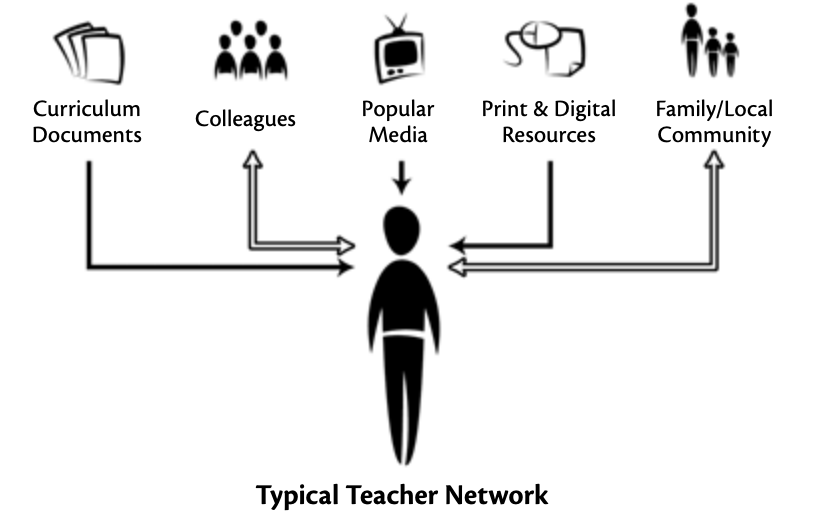
This image shows how there has been a vast change in what we consider a teacher network. This next image shows the ‘new’ networked teacher. Pg 124
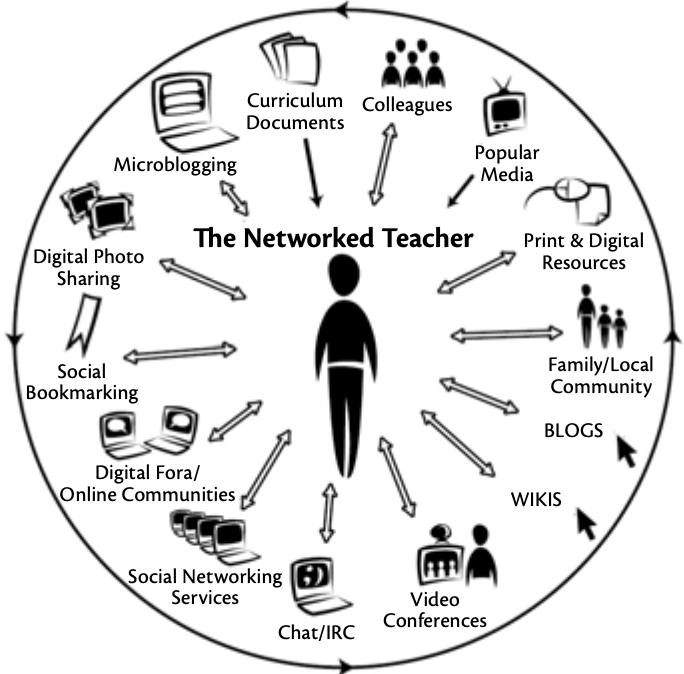
It illustrates how individuals connect with others through participation in social media activities such as blogging, wikis, and social networking, while highlighting their role in both consuming and creating content.
Veletsianos, G. (Ed.). (2010). Emerging technologies in distance education. Athabasca University Press. https://doi.org/10.15215/aupress/9781897425763.01
Trilling, B., & Fadel, C. (2009). Digital literacy skills. In 21st century skills: Learning for life in our times (pp. 65–81). Jossey-Bass.
Leave a Reply