In this assignment, we decided to look at educators and how they stay informed within their PLN’s. We looked through research that helped us answer our consideration questions that helped us form the assignment. Our work was divided into 6 parts, with 5 people taking 2 prompts each and one creating an infographic on each platform when looked into. With there being so many social media sites included in educators’ PLNs, we thought it would be best to target three in more depth. The three we chose were Instagram, TikTok and Facebook. Our group worked off a collaborative Google Doc to assemble our project and Canva to create the infographics.
How should a PLN be created, managed, and engaged with? – Raina Hagel
When making a PLN, a simple way to start it is through social media. Platforms like Instagram, TikTok and Facebook provide easily accessible information from a wide variety of educators (Gray, 2019). You can find plenty of short videos and posts on diverse topics, gaining knowledge and learning new concepts to teaching. Social media provides connections to more perspectives that may not be available to you in-person, and you can easily personalize it to match your beliefs and values. You are able to follow the creators and like posts that you find informative and useful, and the algorithm will provide you with more posts that are similar (Gray, 2019). On Facebook, people are able to join specific communities for education, where teachers can post their ideas or problems and all the other educators in the community are able to learn about these ideas or provide ways to help with an issue. Following experienced educators on social media platforms can help you learn new concepts that may not be taught in school but gained by experience. This can be an especially helpful resource for young teachers who have not had much experience in their own classroom.
As confidence and knowledge grows, so can your PLN. It may begin with commenting on posts on social media that you can relate with, but as you work more, you will also interact with more teachers in your school(s) and community. As your connections grow, you will continue to learn and know about more resources, which you can now share with your network. Building this reciprocal relationship with your more personal network will strengthen your community by building trust, leading to more opportunities for your community to open up and for you to gain more valuable knowledge (Progress Learning, 2026). It is important to build good relationships with the young teachers as well because they have learned all the new policies and methods of teaching based on more recent research and psychology; in return, you are able to share what knowledge you have gained from experience working in the classroom, which they may not have as much exposure to. This reciprocity is what builds the strongest, most successful relationships in a PLN (Emelo, 2023).
To keep your connections within your PLN strong, it is important to continuously engage with the people in your network/ community (Progress Learning, 2026). Within your school, consistent conversations and check-ins should be a priority during the school week, helping build a strong and unified support system within the building. For connections in your community, exchanging contact information such as an email or phone number allows for easy communication to support each other. A well-developed PLN should be an open space for your connections to be able to reach out whenever they need help, going beyond to make the network feel like a continuously supported community (Dene Poth, 2023).
Benefits/Negatives and what features make these platforms effective for learning – Ella Parker
Instagram is a popular social media platform that enables teacher collaboration and professional support, but its role in education has been explored only minimally by researchers.Richer et. al give three main collaborative activities among teachers that are used on the platform of Instagram. These are information seeking, information sharing and co-creating. Engaging in these collaborative activities also indicate higher emotional, informational and instrumental support felt by teachers.
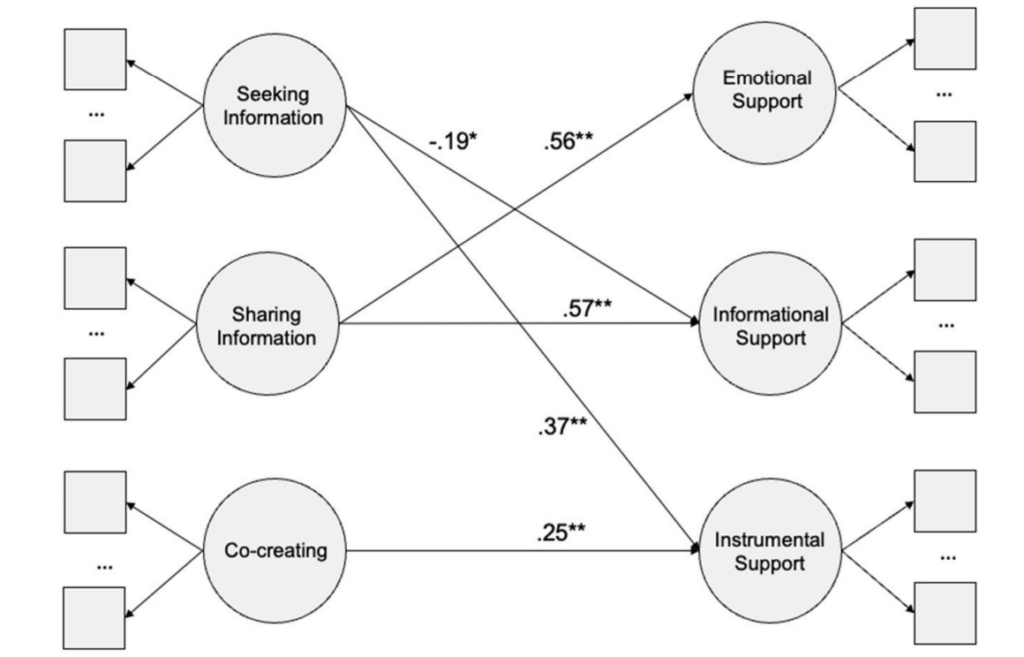
Fig. 3. Direct effect model: Relationships between seeking information, sharing information and Co-creating and digital social support scales.
Instagram’s design, functionality, and visual nature may distinguish it from comparatively more text-focused platforms and could contribute to teachers using the platform differently from other social media (see Pittman & Reich, 2016; Shane-Simpson et al., 2018).
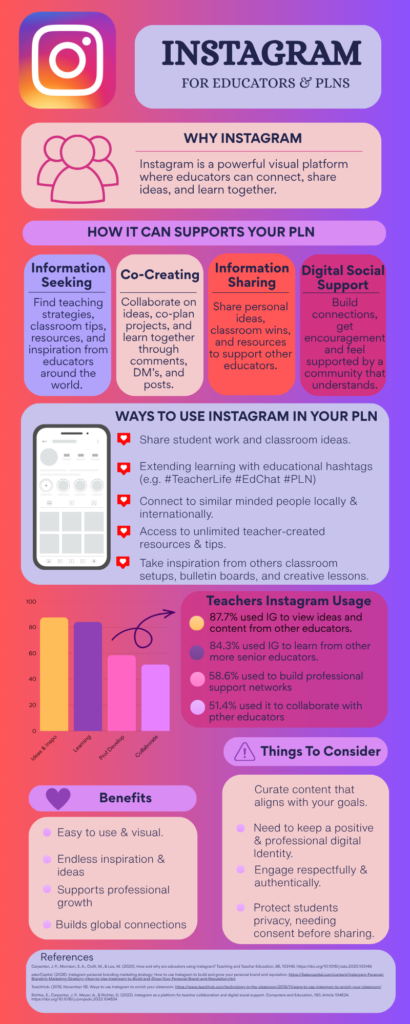
Instagram is often referred to as the world’s largest teachers’ lounge because it provides educators with access to thousands of teaching ideas, classroom resources, and professional learning opportunities. Through educational hashtags, teachers can discover new strategies, share student work, connect with educators around the world, and exchange resources and best practices. These connections help expand professional networks while also supporting the development of technology integration and innovative teaching skills.
Tik Tok
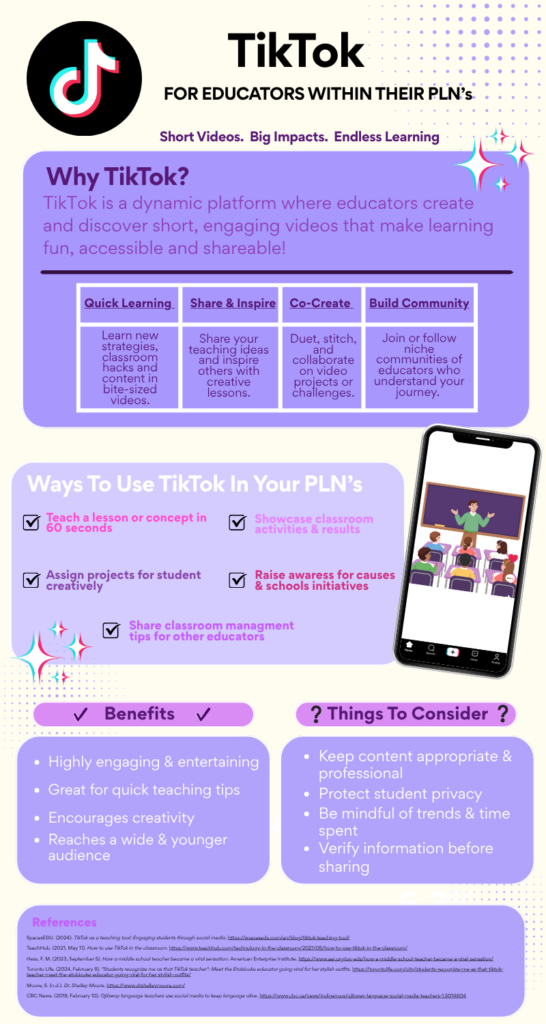
TikTok can serve as an extension of the classroom by allowing educators to create short, engaging versions of their lessons that students can revisit anytime for review or to catch up on missed content. The platform can also be used to encourage student creativity and expression by having students take on the role of teacher, creating their own short-form videos to explain concepts and demonstrate their understanding of course material.
Examples of educational uses include:
- Generating awareness about school events, programs, and initiatives
- Showcasing final projects and student achievements
- Teaching or reviewing lessons through short, engaging videos
- Supporting student activism and advocacy for important social or community issues
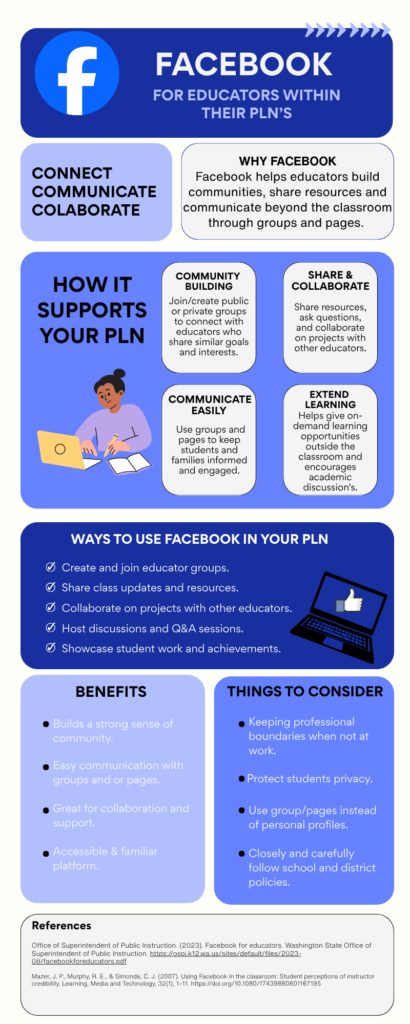
Looking specifically at Facebook’s pages and groups feature, it can be used to enhance communication and collaboration between teachers and students while maintaining professional boundaries. Rather than connecting through personal friend requests, teachers can create dedicated class groups or pages where students can ask questions, share resources, collaborate on projects, and participate in discussions. These online spaces extend learning beyond the traditional classroom by providing students with ongoing access to course materials, peer support, and opportunities for on-demand learning and engagement.
Research by Hull, 2014, suggests that Facebook can be an effective tool for sharing class information, announcements, and updates in a timely manner. The platform can help foster a stronger sense of classroom community by creating opportunities for communication and interaction beyond scheduled class time. Students who participated in classes with a Facebook page generally expressed interest in seeing more instructors use similar platforms.
While studies have not found a significant impact on students’ overall perceptions of a course or direct improvements in academic outcomes, Facebook appears to be most valuable as a supplement to traditional instruction rather than a replacement for it. Teachers can use the platform to extend learning beyond the classroom, encourage academic discussions, showcase student work, and increase engagement by connecting with students through a tool they already use regularly.
How technology allows you to enhance/develop your digital identity/reputation and the social considerations that should be accounted for – Katie Winchester
Instagram:
Instagram allows you to enhance/develop your digital identity/reputation as according to the FasterCapital, article, Instagram Personal Branding Marketing Strategy: How to Use Instagram to Build and Grow Your Personal Brand and Reputation, it can be used as your own personal brand (FasterCapital, 2026). It is important to be authentic when building your digital identity online as it adds credibility and realism to your account. The article also discusses strategies on content curation for viewers. When it comes to using instagram for teachers, you can gear your content to fellow educators, or if you choose not to post, you can still find inspiration from other teachers/educators who share content online. Linkedin also shared tips and tricks when it comes to enhancing your digital reputation and while many were similar to the FasterCapital article, Linkin also shared the importance of interacting with your community. Even in this EDCI 338 course, one of the readings talked about the importance of networking before you need the network for yourself to help build your connections within a community.
TikTok:
In Arantxa Vizcaíno-Verdú and Crystal Abidin’s, research article TeachTok: Teachers of TikTok, micro-celebrification, and fun learning communities, it states that “while Instagram was not created for educational purposes, it can positively benefit professional educators who use it to exchange knowledge” (Vizcaino-Verdu & Abidin, 2023). The article also discusses how the push to online education during the covid pandemic also led to a rise in social media use. With many young people using social media and TikTok it led to the rise of “TeachTok” (Vizcaino-Verdu & Abidin, 2023). Where teachers could share or gain information in creative lesson planning or classroom set ups. It is now a fairly popular way to gain inspiration as a teacher or someone within the education community.
Facebook:
According to the article, A Teachers Guide to Using Facebook, written by Bernadette Rego, it discusses tips on how to grow your PLN as an educator on Facebook. The article discusses how beneficial it can be to join pre-existing groups on facebook to stay in the loop about any news or information in the education field, look for individuals who have good blogs or information to share on facebook, if you are using a professional facebook profile it can be beneficial to share information, resources, or links, that you find important/usefuL (Rego,pg. 17-18) This follows the idea of networking before your require the network. It is also important to consider the groups you are joining before you join them as you have a professional image to hold (Rego, pg. 16)
Social Considerations for social media platforms – Katie Winchester
Social considerations should always be accounted for when posting anything online on platforms such as Instagram, Tiktok, or Facebook. The Tech Advocate article, The Dos and Don’ts of Social Media for Teachers by Mathew Lynch disscuses the importance of knowing what is appropriate/inapropriate to post publicly as an educator. When it comes to any social media, teachers should be aware of what they are posting as it can affect their professional life/careers (Lynch, 2023). It is important to avoid posting pictures/videos of your students(without proper consent), following/accepting students on social media platforms, engaging in hurtful or unprofessional behavior online, or sharing any confidential student information to the public (Lynch, 2023).
PLNs, Data Collection, and Privacy Policies – Maya Stevens
As the digital age progresses and we are granted more access to information, it is important to be mindful of what information we are putting out into the world ourselves. Data tracking has become at the forefront of platforms curating the personalized algorithms that we love so much, but we often don’t pause to question how we are being tracked and if it is truly beneficial to us.
What are the ways the technology tracks and uses your data?
Platforms such as Instagram, TikTok, and Facebook track data in many ways, the most obvious that all users are aware of which is through the information you provide when signing up (name, date of birth, etc.), the content you interact with (creators you follow, likes, views, and shares), the content you put onto the platform, as well as communications. In the Instagram Data Policy, you can find details on the data that is tracked beyond this, such as information from your device, including Wi-Fi access points, GPS, and even your phone percentage! When platforms share a parent company, such as Instagram and Facebook, which are both owned by Meta, your data can also be shared between the platforms, so even if you do not consent to your data being shared on one platform, the data has already been accessed by the parent company.
How can data tracking be used to benefit a PLN?
Companies use your data in multiple ways; the article What Data Do Social Platforms Collect, states the biggest goal of these platforms is to encourage further engagement by tailoring your algorithm to fit content you have previously engaged with. Platforms will also send you targeted ads and attempt to sell you products they think you’ll be interested in. Although data collection can be frightening, it can also be incredibly beneficial to your PLNs, as companies tailor your algorithm towards your interests, which allows you to interact with content more relevant to you and your profession. This lessens the “doom-scrolling” or “time filler” aspect of social media by providing you with more useful or informative content. Data collection can also help you build connections with others in your profession; oftentimes, you will receive suggestions to follow people “in your community” or suggest creators who represent a similar standing/profession as yourself and can further educate you, provide advice, or give you further inspiration for your work. In the case of educators, the more academic content they interact with, the greater the chance their algorithm will be filled with educational content, classroom learning, and advice from other educators. For example, many educators use social media to help curate lesson plans and classroom activities. Connecting with others from your community also allows you to share your own content and put yourself out there, which is the biggest goal for PLNs.
What are the strengths of the privacy, security and acceptable use policies for the social media platforms? – Maya Stevens
Platforms may take a lot of data when you are interacting with the chosen media; however, most companies are quite open about what information they are taking from you, as well as what they will provide you with in return. Companies will often ask you to agree to a privacy policy or consent to “cookie collection” before allowing you to engage with their site. Many of the policies also allow you to customize the amount of data collection for more privacy. Companies will often allow you to customize the cookie settings to “only necessary,” and when you no longer wish to engage with the media, platforms will often delete not only your account but the data that came along with it when you signed up. This completely wipes your history for others to see immediately, but the parent company often takes longer to get rid of your information from their servers. Finally, social media platforms in Canada are required to follow PIPEDA requirements, a legally binding document that helps protect Canadian citizens’ data.
What are the weaknesses of the privacy, security and acceptable use policies for the social media platforms? – Maya Stevens
For every strength that comes along with the privacy policies, there are many weaknesses that platforms are able to exploit. Privacy policies and agreements that are provided to users are often lengthy, and users do not fully read them before agreeing, leading to important information often being overlooked and users not being fully informed about what they are consenting to. Included in these privacy agreements is the discussion of cross-content sharing, which, as discussed above, allows for platforms owned by the same parent company to share data between one another, even if you are only active on one platform. Data collection can become excessive at times, and eventually, most of the data being collected is not beneficial to the user; they don’t know where/who their information is going, and they are no longer an informed user. Consenting to data collection also becomes an issue when policies are constantly changing, and users are minimally informed. Often, when policies are changed, users are not required to reconsent, leaving them even less informed.
What can I do to remain informed? – Maya Stevens
As a future educator, it is extremely important to be mindful of what you are putting out into the world, both purposefully through content sharing, and through data sharing when engaging on social media platforms. It is important to remain informed on media literacy and how your information is shared on the web. Educating not only yourself but others allows you to protect your professional standing and keep your PLN positive, engaging, and encouraging for others to engage with. If you are using social media for your classroom, it is important that you ensure that students are not involved in your content in any way, as well as the school you are teaching in. If you are to put this kind of information onto your PLN, companies are able to collect that data, whether you consented or not; this puts both your professional standing and your students at risk. When engaging online, ensure that you are doing so on a private device, such as a cellphone, rather than a school computer, as websites are able to access photos and locations on devices. Before engaging online, be careful to thoroughly read through privacy policies, to be confident in the fact that the information you are sharing is what you want shared, and that no sensitive data can get out to other third parties.
In conclusion, data collection can be a powerful tool for developing your PLN if you remain informed on what you are consenting to. It is also important that users are mindful that when on media apps, everything they do is being watched, even if they are not directly interacting with certain content; it is still being tracked. This is important for educators to keep in mind because the media you interact with represents who you are, and others are able to see that as well. Data tracking is not necessarily a bad thing for users, as it allows for the customization of algorithms and furthers the chances of meaningful connection, collaboration, and professional content curation for your PLN.
Provide examples of individuals who have used a PLN to become leaders in a field of interest, and discuss their presence on the platform. – Amelia
- How do they use social media platforms to build their reputation/presence? – Amelia
What individuals have used PLNS to become leaders in education, and how did they build their presence. – Amelia Both
Gabe Danneburg
Gabe Dannenburg is a middle school science teacher from South Dakota. In 2020, Dannenburg had filmed his reaction to surprising his students by playing Kahoot. He decided to post his video on TikTok as you could hear the students’ excitement, and it ended up viral with 40million views that night. His content is guided towards teaching, schooling, and education, with the primary audience being other teachers and parents. When posting videos as an educator, he has the mentality of, “If my principal got a complaint about this video, can I defend my actions.”(Hess, 2025). However, his school admin believes social media is a great way to build rapport with students and their families. Dannenburg is active on TikTok, Instagram, Facebook, and Youtube, however, most of his following is on TikTok. With this PLN, He has been fortunate to work in collaboration with mainstream brands to help other educators and students.
Zahra Hassan
Zahra Hassan is a middle school teacher from Ontario who shares teacher outfit inspiration on TikTok. She started posting on Tiktok after her students persuaded her to post her stylish outfits, going viral. With posting her weekly outfits, she helps teachers break the cliché of “teacher outfits”. However, her main motivation for posting her outfits has nothing to do with fashion. Her main goal is “to show young people that they can have their dream career even if their capabilities have been doubted.” (Slone, 2023). She also posts relatable content for teachers, such as relating popular sounds to a day in the classroom, or sharing resources for teachers. Hassan also uses the power of social media to show her students that she is a real person, and that school is meant to be fun, not boring.
Shelley Moore
Shelley Moore is a former teacher, who is now an Inclusive Education speaker and consultant. She holds a Bachelor’s degree in Special Education, with her Masters degree and PH.D. in inclusive education theory and practices. With these, she focuses on educating teachers, schools, and the general population on inclusive education, delivering these resources mainly through Youtube and other social media platforms. Her Youtube account has many popular videos on educational topics, with mentions as well by the Government of Canada and Tedx. With the platform she has created herself, she travels throughout North America, giving keynote speeches at conferences, and to school districts on Inclusive Education.
James Vukelich and Roy Tom
James Vukelich and Roy Tom are both Indigenous language teachers, using the power of social media to teach Ojibway outside of the classroom. These teachers go on Facebook live to teach “words of the day” once a week, with the intention to connect with language learners across the country. Vukelich had decided to teach Ojibway, the language that his family lost due to residential school, after taking a language course to be able to get financial aid for post secondary schooling. He was fascinated by the language, and became an Indigenous language specialist, helping develop curriculum and training Indigenous language teachers. For Tom, he attended a workshop where a Cree elder had mentioned it was everyone’s responsibility to teach the Indigenous language. This led him to the idea of teaching the language through videos on Facebook. Tom then set up a group on Facebook, which he posts his language videos on, with nearly 800 members. With teaching Indigenous language online, Vukelich and Tom are able to explain their PLN across Canada with those willing to learn Ojibway.
How will you know that your PLN is a success? – Raina Hagel
A successful PLN will contain people and resources that a person can interact with, helping to gain more knowledge and perspectives on topic(s). For educators, this would be specific to teaching and managing a classroom. A strong PLN should provide diversity to your perspective, aid you in problem solving, continuous learning opportunities, potential collaboration/ career opportunities, and should lead to continuous growth in your practice (Emelo, 2023). Personal Learning Networks are supposed to be well-rounded, covering multiple aspects that can advance your understanding for your career. For education, this would include areas such as lesson subjects, teaching methods, organizing a classroom, planning schedules, managing students and dealing with their various emotions, essential classroom materials and where to get them, and how to make a positive impact for the school and with the staff.
The purpose of a learning network is to broaden your understanding and expand your way of thinking about different matters (Emelo, 2023). It should be personalized to your beliefs, but not limited to one narrative. Educators need to be open-minded, a growth mindset gives teachers the opportunity to develop a better understanding for the students that they are and will work with; a diverse PLN can help create this base for teachers to be able to rely on. Ideally, a successful PLN should be a safe space that provides reciprocal contributions, sharing ideas and perspectives to one another and creating meaningful discussions that can help expand each other’s understandings (Dene Poth, 2023).
Although a large learning network with lots of resources can be helpful, the best way to know if your PLN is a success is the results you will see in the classroom (Langemeier, 2026). Your classroom may be better organized, you could be more efficient and engaging in your lessons, problems can be solved faster, and you feel like you have support that you can turn to when you need help. Ultimately, you can make the best professional learning network you possibly can, but it can only become a success if you actively use your resources and put what you have learned into action to see direct change in your own success in the classroom and life.
Our chosen platform and Infographic’s for PLN’s for teachers – Hana Blaicher
Putting together these Infographic posters helped me realize that the three platforms we focused on being TikTok, Instagram, and Facebook are often thought of as social platforms, but they are more than that. They are used as a multi-tool and in this case for professional learning, to share ideas, build communities, and find a support system all while promoting professional growth.
While creating the posters, one thing that stood out was some of the common things we found across all the platforms and how educators connect and learn from each other. This can be through videos, posts, in groups, or even through discussions in specific forums or in comment sections. One of the other things I noticed is that when educators are posting in a professional sense they need to be mindful of their digital identity, and how things shared online are public and viewable to everyone.
While the platforms have similar areas, they each have their strengths. Instagram’s visual take on posting is a great way to share classroom ideas and inspiration in many ways. TikTok is similar but also is quicker and more engaging through the short videos, and is perfect for a teacher who has many things on the go. Facebook’s platform helps open a space for deeper conversation and depending on the type of group or forum you are in can help you get feedback from people that feels real. Overall, what I have noticed is that there are no “perfect” platforms when developing your PLN. Each platform has different ways that educators can build their network, connect with similar people and continue to grow professionally and it is up to the educator what they want and are looking for.
References
Raina Hagel
Leveraging Social Media to Build a Digital Professional Learning Network | Edutopia
Networking in Education: Build a Professional Learning Network
Professional Learning Networks for Teachers | Edutopia
Ella Parker
https://www.sciencedirect.com/science/article/pii/S0360131522001956
https://spacesedu.com/en/blog/tiktok-teaching-tool
https://ospi.k12.wa.us/sites/default/files/2023-08/facebookforeducators.pdf
https://www.researchgate.net/publication/264816593_Using_Facebook_in_the_classroom
Katie Winchester
Facebook Use for Teachers: A Guide | PDF | Facebook | Social Networking Service
How to Manage Your Online Reputation on Instagram
The Dos and Don’ts of Social Media for Teachers – The Tech Edvocate
TeachTok: Teachers of TikTok, micro-celebrification, and fun learning communities – ScienceDirect
Maya Stevens
What Data Do Social Platforms Collect, and How Can You Reclaim It?
Data tracking: What is it? Why is it important?
Data Policy | Instagram Help Center
PIPEDA requirements in brief – Office of the Privacy Commissioner of Canada
Amelia Both
https://www.aei.org/op-eds/how-a-middle-school-teacher-became-a-viral-sensation
https://www.drshelleymoore.com
https://www.cbc.ca/news/indigenous/ojibway-language-social-media-teachers-1.5014604
https://www.youtube.com/@FiveMooreMinutes
Hana Blaicher
Blaicher, H. R. (2026). Platforms for teachers within their pln’s [Infographic]. Canva.
Carpenter, J. P., Morrison, S. A., Craft, M., & Lee, M. (2020). How and why are educators using Instagram? Teaching and Teacher Education, 96, 103149. https://doi.org/10.1016/j.tate.2020.103149
Leave a Reply